CS2 Case Opening Odds 2026: The Real Numbers (Knife = 1 in 400)

Posted on in CS2
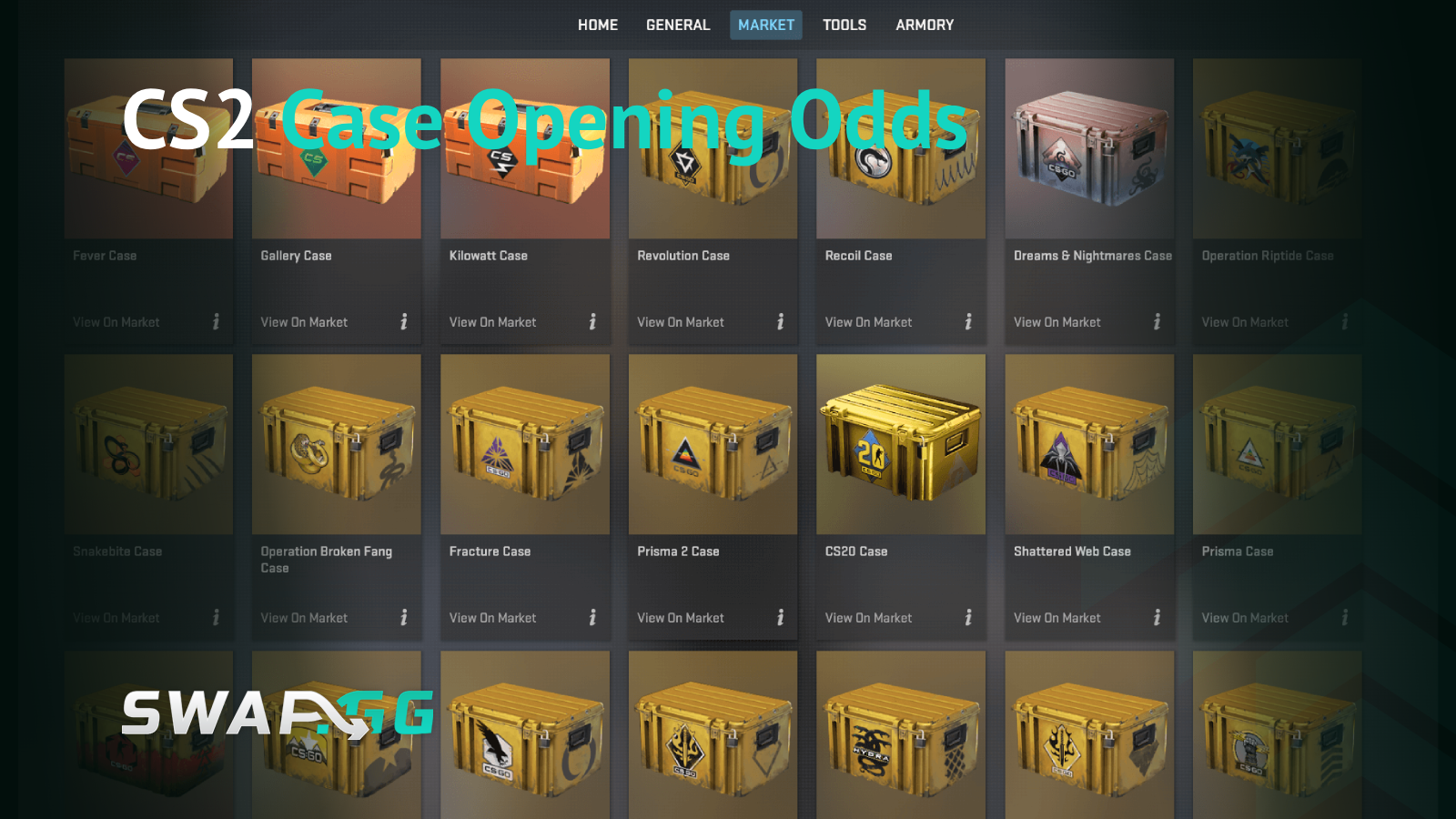
A number that has not changed since 2017 is currently sitting at the center of a New York courtroom argument over whether it should be allowed to exist at all. The Rare Special Item rate in CS2 weapon cases, the tier that produces knives or gloves depending on the case, sits at 0.26%, roughly 1 in 385, a figure Valve disclosed under Chinese transparency regulation back when the game was still called CS:GO. That number alone explains why people keep opening cases. What it does not explain on its own is what 0.26% actually feels like across a real session, or why a Manhattan court is currently weighing whether that same disclosed percentage amounts to illegal gambling.
The Official Drop Rates
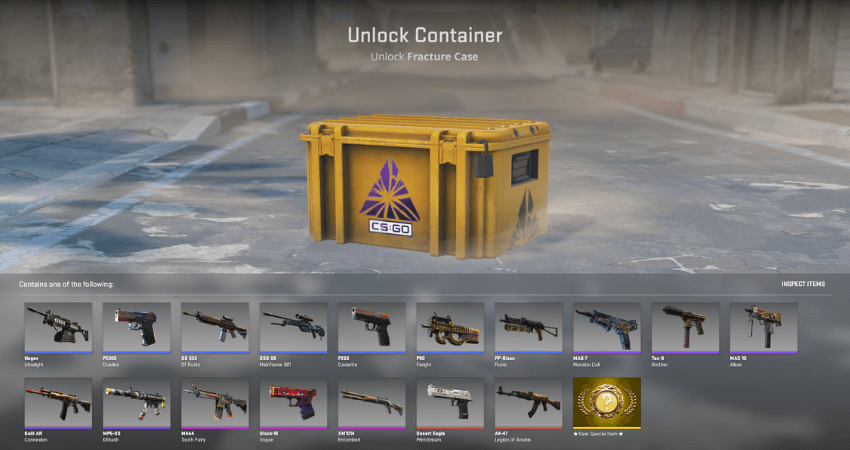
These numbers, 79.92% Mil-Spec, 15.98% Restricted, 3.20% Classified, 0.64% Covert, and 0.26% Knife/Gloves, were the first official confirmation of what the community had long suspected. For years, Counter-Strike case odds were a mystery, until China's Ministry of Culture required all games with loot boxes to publicly disclose drop rates in 2017. Valve complied by publishing the exact probabilities through Perfect World, their Chinese publishing partner. The disclosed rates have remained unchanged from CS:GO through CS2.
Each rarity tier is 5 times rarer than the one below it, as a simplification of the published odds rather than a fixed rule across every container type, except the Rare Special tier, which sits at a 2:5 ratio relative to Covert rather than the standard 5x step. That is why the gold tier lands at roughly 1 in 385 instead of the 1 in 780 you would expect if the 5x pattern held all the way down. Community tracking has matched these published figures closely, with the usual sample-size variation, which is why there is little real debate over whether they hold in practice.
On top of the rarity roll, any eligible drop has an additional 10% chance of being StatTrak. Applying that rate to the 0.26% gold tier puts a StatTrak knife or glove at roughly 0.026%, about 1 in 3,850, though Valve does not publish that combined figure directly. It is a derived estimate, not an officially disclosed number.
What 0.26% Actually Feels Like Across Real Sessions
A percentage on a page does not communicate what it feels like to actually open cases, so here is the probability math worked out across realistic session sizes. With nearly 80% of all drops landing on Mil-Spec, the system is built so the overwhelming majority of any session ends in a low-value common skin, with the rare drop sitting at the far edge of probability.
The cumulative chance of landing at least one gold drop builds slowly and stays uncomfortably uncertain for far longer than most players expect:
- 50 cases opened: roughly 12% chance of at least one gold
- 100 cases: roughly 23%
- 267 cases: roughly a 50% chance of at least one gold drop
- 500 cases: roughly 71%
- 1,000 cases: roughly 93%
Even after 500 case openings, there remains close to a 29% chance of walking away with zero gold drops. CS2 has no pity timer or bad luck protection of any kind. The probability system applies fixed rates independently to every single opening, which means opening 384 cases provides zero statistical advantage on case 385. Every opening is a fresh, independent roll at exactly 0.26%, regardless of your history.
The Real Cost of Chasing a Knife
Valve continues to release new weapon cases periodically, with the standard pattern for recent cases including 17 weapon skins and one knife model offered across multiple finishes, requiring a $2.49 key to open. At that key price, statistically reaching one gold drop costs roughly $958 in keys alone before accounting for the price of the case itself, which adds to the total spend on every opening regardless of outcome.
That figure is a statistical average, not a guarantee, and the dilution inside the gold tier goes further still. A skin must first roll the rarity tier, then separately roll into a wear range, and a specific finish in a specific wear condition with a StatTrak flag represents a small fraction of the already-small gold tier. Wanting a knife is one probability. Wanting a specific knife in a specific finish and StatTrak status is a meaningfully smaller one, often landing in the range of roughly 1 in tens of thousands of openings depending on the exact pool size for that case.
Per case-opening simulation tools and community ROI tracking, average expected return across most active cases sits in the 50-85% range of what you spend, meaning the house edge typically runs 15-50% depending on the case and current market prices for its contents. This shifts daily with market conditions, so any specific percentage quoted today will look different in a month.
Wear Condition Adds Another Layer of Dilution
The skin you get is not just a rarity roll. It also receives a randomized float value that determines its wear condition, and that distribution is not uniform across the five conditions.
A skin must first roll the rarity tier, then separately roll into a wear range that can produce Factory New. Combining the roughly 0.64% Covert roll with the roughly 3% Factory New roll puts a Factory New Covert skin at approximately 0.019%, or about 1 in 5,200. The headline rarity percentage quoted everywhere is only the first of two rolls standing between you and the specific skin you actually want.
The 2026 Legal Fight Over These Exact Numbers
In February 2026, New York Attorney General Letitia James sued Valve Corporation for illegally promoting gambling through video games popular with children and teenagers, alleging that Valve enables gambling by charging users for the chance to win a rare virtual item, with one item reportedly selling for more than $1 million. The complaint asserts three causes of action under New York's constitution and Penal Law Article 225, which defines gambling as staking or risking something of value on a contest of chance under an agreement to receive something of value in return.
Valve filed a motion to dismiss on May 18, 2026, arguing that loot boxes do not fit the statutory definition of gambling at all. "Because every player always receives exactly what he paid for, one skin per mystery box, there is no stake or risk," the filing states. Valve's attorneys argue that skins are not "something of value" under New York gambling law because they are not money, property, or tokens exchangeable for money, comparing the mechanic instead to baseball cards, Happy Meal toys, and comic book grab bags. Valve also points to the fact that it has sold loot boxes openly for over a decade, paid New York taxes on those sales, and that no other state has banned the practice, arguing it had no reason to believe its conduct was illegal.
Valve's defense draws on precedent from California federal courts, where loot box items were ruled not to be "things of value" because they cannot be cashed out for real-world money outside the game itself. New York's lawsuit counters that a player can still convert a skin into cash through a chain of transactions, such as selling it for Steam credit, using that credit toward hardware, then reselling the hardware elsewhere. Whichever way the motion resolves, this is the first major US state-level legal action treating CS2's exact disclosed probabilities as potential evidence of an illegal gambling operation rather than a disclosed, transparent game mechanic.
Some changes have already been forced on Valve by regulators elsewhere: in Germany, Valve was required to add a feature letting players see what is inside a case before opening it, in order to comply with the country's gambling regulations. That single jurisdiction-specific requirement is a narrower mandate than a universal European standard, and regulatory approaches vary meaningfully by country rather than following one shared model.
Valve's own product direction has moved in a way that tracks this pressure, whether by direct response or coincidence. Players can now opt for weekly rewards and avoid randomized item boxes completely if they choose. Newer Terminal-style containers extend that same logic further, showing the specific item and its price before any payment occurs and letting you decline an offer rather than committing blind, which sidesteps the core "stake or risk" argument at the heart of the New York complaint.
The Bottom Line on the Math
If the goal is owning a specific skin, the math consistently favors buying it directly on the market over chasing it through cases. The roughly $958 statistical cost of reaching one gold drop, combined with the additional dilution from wear condition and StatTrak rolls, means the expected cost of "earning" a specific knife through case openings usually exceeds the price of simply buying that exact knife outright on the Steam Community Market or a third-party platform.
If the goal is the experience of opening cases itself, that is a legitimate reason to do it, in the same way buying a pack of trading cards is a legitimate purchase despite a similar expected-value gap. The number worth carrying into that decision either way is the one this entire guide centers on: 0.26%, no pity timer, every single opening independent of every one before it.
FAQ
What are the odds of getting a knife in a CS2 case? Approximately 0.26%, or about 1 in 385 cases, per Valve's officially disclosed 2017 drop rates. This figure has remained unchanged from CS:GO through CS2 and applies to every standard weapon case, with the gold tier producing either a knife or gloves depending on the specific case.
Is there a pity timer for knives in CS2? No. CS2 has no bad luck protection of any kind. Every case opening is a fully independent event at the same 0.26% rate, meaning opening 384 cases gives you zero statistical advantage on case 385.
How much money would it statistically take to get a CS2 knife? At a $2.49 key price, the statistical expectation lands around $958 in keys alone before accounting for case costs, based on the 1 in 385 odds. This is an average, not a guarantee. Some players get a knife in their first 10 cases, others open over 1,000 without one.
Are CS2 cases profitable to open? No, not on average. Expected returns across most active cases fall in the 50-85% range of what you spend, meaning the house edge typically runs 15-50% depending on the specific case and current market prices for its contents. Buying a desired skin directly is statistically cheaper than reaching it through case openings.
Is CS2 case opening considered illegal gambling? That question is currently being litigated. New York Attorney General Letitia James sued Valve in February 2026 alleging CS2's loot box system violates the state's gambling laws. Valve filed a motion to dismiss in May 2026, arguing that because every player always receives an item, there is no stake or risk under the legal definition of gambling, and that skins do not qualify as "something of value" under New York law. The case had not been resolved as of this guide's last update.

Posted on in CS2