CS2 Pets Can't Be Traded, and That's the Point

Publicado el en CS2
You can't trade CS2 pets, and the restriction is built into the item itself rather than enforced by any platform. The chicken pets that arrived alongside the Rush 3v3 mode in the September 2026 update are permanently bound to the account that hatched them, so there's no trade window, no marketplace listing, and no workaround that moves a chicken from one player to another. The egg doesn't even appear in your standard Steam inventory, which is why no third-party site can list it. Everything else in your CS2 inventory still trades normally, and the gap between the pet system and the market is the entire point of how it was designed.
Why CS2 Pets Cannot Be Traded
The restriction is applied to the item at the moment you claim it from your Weekly Care Package and stays in place through every stage of growth. Valve flagged the Chicken Egg, the Chicken Feed, and each subsequent life stage as untradeable, so the standard Steam trade offer window never sees them, the Community Market listing form rejects them, and no bot API can move one between accounts.
A CS2 pet is a chicken hatched from a Chicken Egg obtained through the Weekly Care Package. Pets progress through four growth stages over roughly five months, can be named and photographed, and remain permanently bound to the account that raised them. They cannot be traded, sold, or transferred under any circumstances.
The design choice is unusual for a game that has spent a decade monetizing every other cosmetic item. Skins drop from cases and trade on multiple platforms. Agents can be bought and sold. Stickers move like currency. Charms attach to weapons and trade like any other inventory item. Pets are the first cosmetic addition to CS2 that exists entirely outside the market, and Valve built it that way on purpose.
What the Restriction Blocks
Everything that involves moving the pet somewhere else is blocked at the account level. You can't send it to another player, list it on the Steam Community Market, use it in a trade-up contract, move it to a Storage Unit, or gift it to a friend. The pet is yours, and it stays yours until it leaves on its own.
What You Can Still Do With a Pet
You can name it, take screenshots with it in the main menu, let it sit on your shoulder in the loadout screen, and bring it into matches once it reaches the pullet stage. Everything about the pet system is personal rather than transactional, and none of it changes the fact that the chicken has zero resale value.

How the Chicken Pet System Works
The pet system runs on a weekly cycle that costs you real inventory value every time you participate. A Chicken Egg can appear as one of the options in your Weekly Care Package, and choosing it consumes both of your reward slots for that week. That means you give up a weapon case, a skin, or any other marketable drop in exchange for a pet you can't sell.
The life cycle has four stages, and each one runs on a different timer.
Feeding is the mechanic that keeps the pet alive. Chicken Feed also comes from the Weekly Care Package and also consumes both reward slots, so keeping a pet through all four stages requires a sustained commitment of weekly drops. If the food meter runs out, the pet leaves permanently and frees the slot for a new egg.
Body Types and Colours
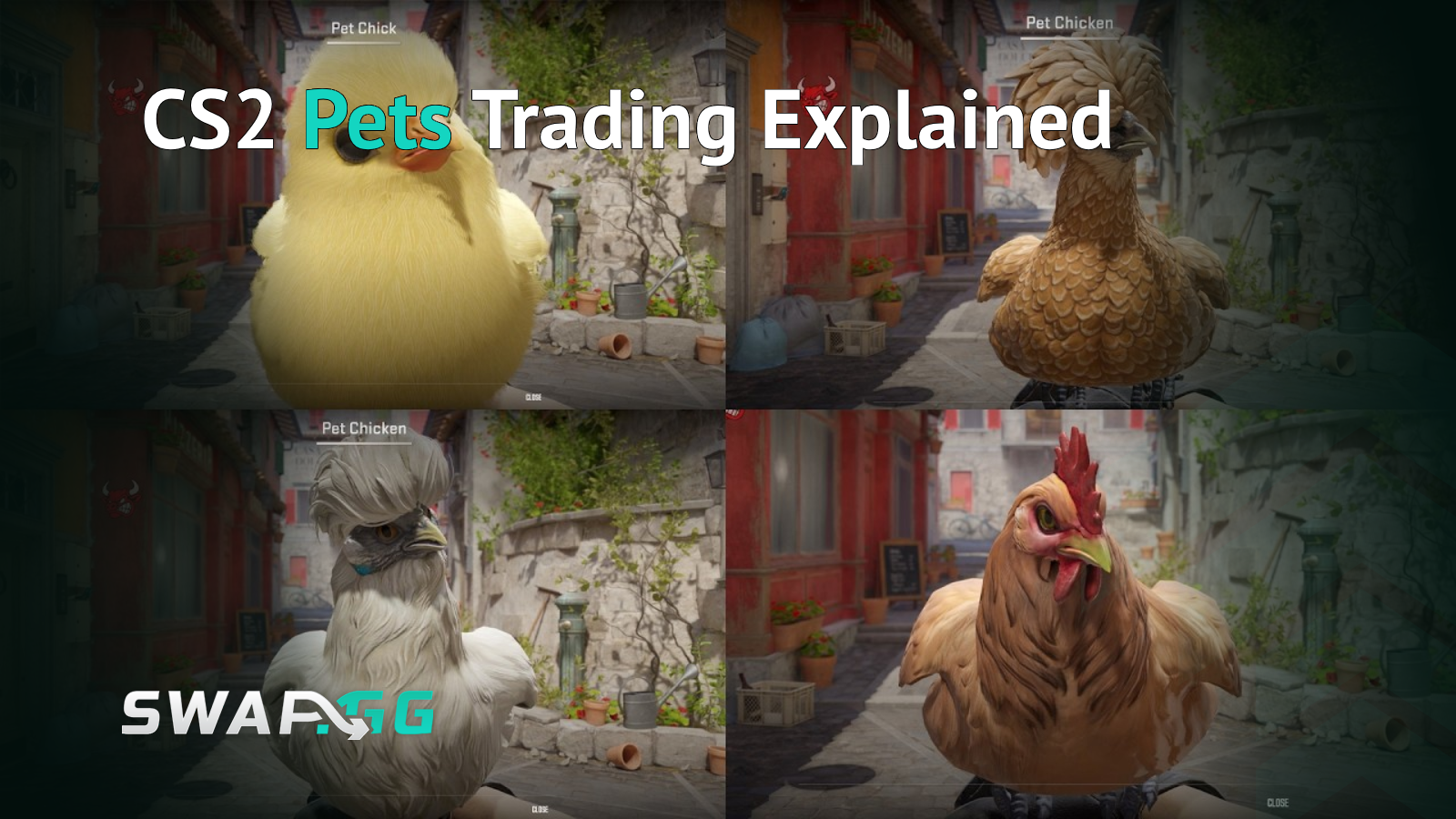
Three body types exist in the game files, each rolling into a different set of colour variants when the chick grows into a pullet. Community data-miners have named these body types Catalana, Silkie, and Polish based on the real-world chicken breeds they resemble, though Valve hasn't officially confirmed those names.
Combining the three body types with their colour pools produces roughly 34 to 35 visual variants in total. The colour itself is random and can't be influenced, the same logic Valve uses for case openings. The difference is that a rare chicken colour has no resale value at all. It's a personal flex, not an asset.
What You Can Trade Instead
If the goal is to move value between accounts or cash out inventory, the pet system is irrelevant. The items that trade are the ones that have always traded, and swap.gg supports all of them.
Skins
Weapon skins remain the core of the CS2 economy. The AK-47 Redline, AWP Asiimov, and the entire spectrum from industrial-grade fillers to covert-tier grails all move through the market. The 7-day Trade Protection window applies to anything received through a player trade, so any flip takes at least a week to complete.
Agents
Agents replace your in-game character model and trade exactly like skins. The Shattered Web Agents collection spans 22 items across four rarity tiers, with entry costs around $3.30 and the most expensive agent sitting near $14. There's no case to open and no trade-up path for agents, so the open market is the only way to get them.
Stickers
Stickers are the most volatile and most collector-driven part of the CS2 economy. A Katowice 2014 Titan Holo has changed hands for over $100,000, while the cheapest paper variants from the same event trade around $400. Sticker liquidity varies wildly by event, team, and finish, making them the highest-risk, highest-reward category on the market.
Charms
Weapon charms arrived in the October 2024 Armory update and trade like any other inventory item. They attach to weapons and can be bought, sold, and traded on the Steam Community Market and third-party platforms.
How Trading Works on swap.gg
If you want to move value between accounts or cash out inventory, the items above are where the action is. The process on swap.gg takes four steps.
- Connect your Steam account. Sign in through Steam's official authentication. You'll need your Steam Trade URL, which is in your Steam account settings under trade and privacy settings.
- Load your inventory. Your CS2 items appear automatically. Browse the skins, agents, stickers, and charms you want to trade.
- Select the items and check the quote. swap.gg prices update in real time based on current market rates, and the quote you see is the value you receive.
- Accept the trade and wait for the hold. Once you confirm, the bot accepts the item. Because Trade Protection applies to anything received through a player trade, the payout is held until the seven-day reversal period expires. After that, the funds are released.
There's no pet inventory on swap.gg, no pet market, and no way to list a chicken for sale. The pets exist in the game client and nowhere else.
The One Scenario Where Pets Could Become Tradeable
Valve changes rules all the time, and nothing stops the company from flipping the untradeable flag on pets in a future update. If that happened, every chicken currently sitting in a nest would instantly become a tradeable item with a market price, and the people who've been feeding their pets for weeks would own something with real value.
That possibility isn't a reason to treat pets like an investment today, though. The flag has been in place since the system launched, Valve hasn't hinted at changing it, and the entire design of the pet system points away from market participation. The Weekly Care Package trade-off only makes sense if the pet is a personal choice rather than a speculative asset, which is exactly why the untradeable restriction exists in the first place. If you want to own something that might appreciate, buy a skin. If you want a chicken that follows you around in the main menu, raise a pet.
FAQ
Can I trade a chicken in CS2?
No. Chickens, eggs, and Chicken Feed are all permanently bound to the account that earned them. There's no trade window, no market listing, and no third-party workaround that moves a pet from one player to another. The pet doesn't appear in your standard Steam inventory, which is why no platform can list it.
Can I sell a CS2 pet for real money?
No. The pet has no market price because there's no market for it. Any listing claiming to sell a chicken is a scam, and any site that says it can transfer a pet is either lying or planning to take your money and disappear. Valve has never enabled pet trading, and there's no indication that will change.
Why did Valve make pets untradeable?
The pet system was built as a weekly engagement mechanic rather than a monetization feature. Making pets tradeable would have turned them into another speculative asset and undermined the retention purpose. The Weekly Care Package trade-off, where choosing an egg costs you both reward slots, only makes sense if the pet is a personal choice rather than an investment.
What can I trade instead?
Skins, agents, stickers, and charms all trade normally on the Steam Community Market and third-party platforms like swap.gg. Items received through a player trade carry a seven-day Trade Protection window before they can be sold again, so any flip takes at least a week to complete.
Do pets have any market value at all?
No. A rare chicken colour might feel like a flex, but it has zero resale value. The only value is personal: the screenshots, the progress you tracked, and the time you spent feeding it before it left. If you want something that holds value, buy a skin. If you want a chicken that follows you around the main menu for a few months, raise a pet.

Publicado el en CS2