Valve Bans 960,000 CS2 Bot Accounts: What It Means for the Economy

tarihinde, CS2 kategorisinde yayınlandı
For years, queuing into a CS2 Deathmatch and finding half the lobby standing completely still was just something you accepted. The accounts were there, they were not playing, and nothing seemed to happen to them. On March 26, 2026, Valve answered that with 960,000 simultaneous bans targeting the exact network of automated farming accounts that had been clogging servers and quietly suppressing the skin economy while everyone watched.
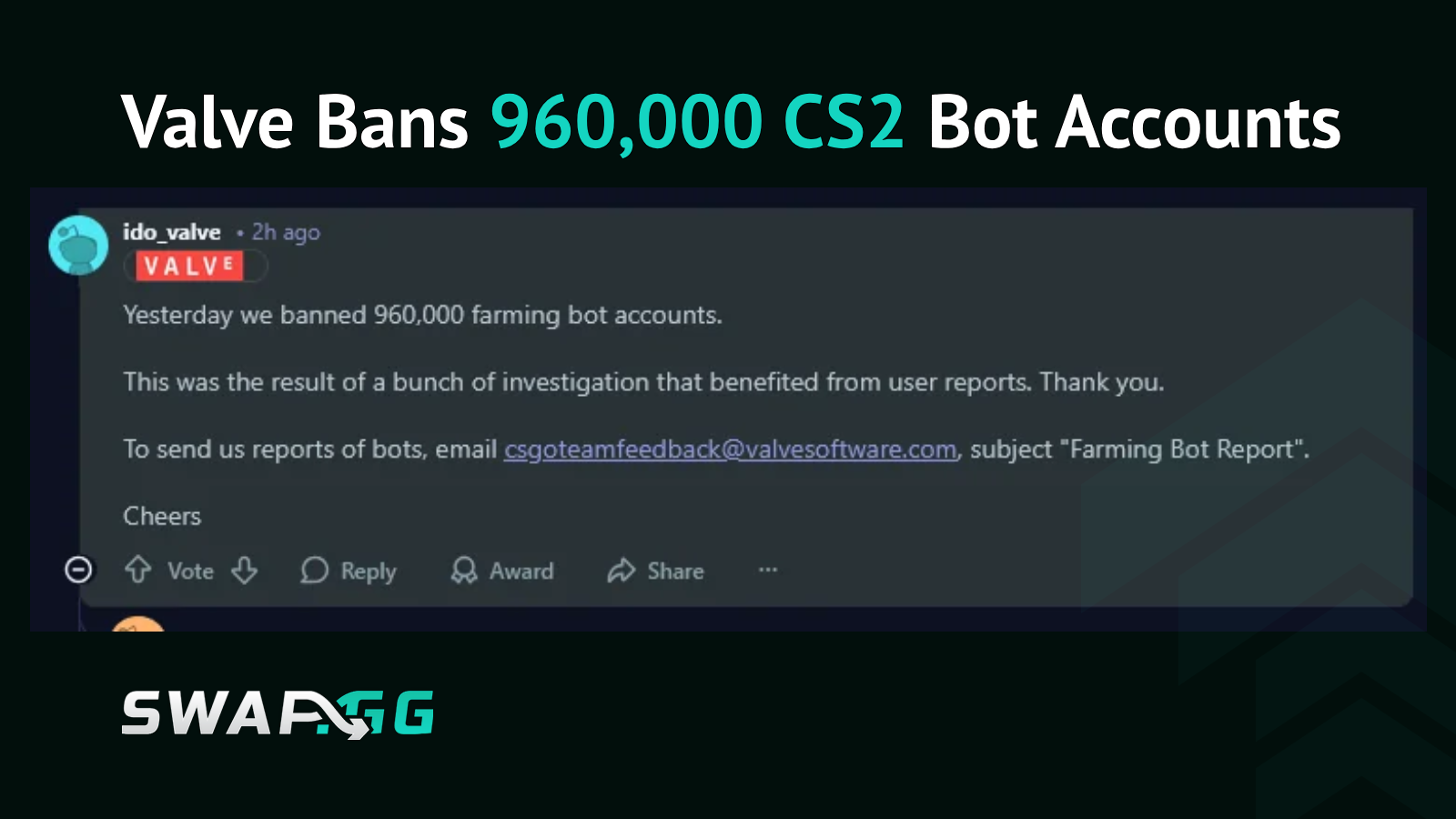
CS2 project lead Ido Magal confirmed the number on Reddit the next day, responding to a thread where players had already noticed an unusual spike in ban counts: "Yesterday we banned 960,000 farming bot accounts. This was the result of a bunch of investigation that benefited from user reports. Thank you." He also asked the community to keep sending reports to csgoteamfeedback@valvesoftware.com with the subject line "Farming Bot Report."
To put that number in context: previous ban waves within CS2 had peaked in the tens of thousands. The March 26 action is the largest single-day enforcement in CS2's history by an enormous margin, and it sets a new standard for what Valve is willing to do when it targets the farming side of the game's economy rather than competitive cheaters.
What These Bots Were Actually Doing
Farming bots are not the same as aim bots or wallhack users. They never competed in ranked modes, never needed to cheat in the traditional sense, and in many cases never fired a shot. Their purpose was purely economic: join a Deathmatch lobby, accumulate enough play time to qualify for the weekly item drop, and repeat. Operators running these networks did not play CS2 themselves. They ran dozens or hundreds of client instances simultaneously using automation software, letting accounts sit idle or loop through scripted movements to avoid basic AFK detection while the timer ticked down.
The economics behind this are what made the problem so persistent. Each account generated a small number of skins and cases per week, worth anywhere from a few cents to a few dollars depending on the drop. Spread across a hundred accounts running in parallel, an operator could pull in several hundred dollars weekly from farming alone. Industry estimates from bot farm developers suggest that case farming across all operations collectively generated upwards of a million dollars per month, though this figure is based on developer-sourced reports rather than verifiable external data and should be treated as an estimate. When the numbers are even half that large and the barrier to entry is just an account creation and some automation software, the incentive to rebuild after every ban wave is obvious, which is why this had been running for years.
Many of the banned accounts were not pure farming bots in isolation, either. Community analysis before the ban wave identified a two-stage structure: farming accounts accumulate items, then transfer them to separate "warehouse" accounts that hold inventory before gradually selling it through the Steam Community Market or third-party platforms. Previous enforcement actions largely targeted the active farming accounts. The March 26 wave appears to have been broader, reaching the warehouse accounts that had held and distributed the farmed supply, which had mostly been untouched until now. That distinction matters because disrupting the storage side of the operation hits the financial output, not just the production capacity.

The Ban Type and What It Actually Means
Most affected accounts received Game Bans rather than full VAC (Valve Anti-Cheat) bans, and the difference is meaningful and worth understanding. A full VAC ban is permanent and platform-wide: it excludes the holder from every VAC-secured multiplayer game across all of Steam, prevents all item trading, and removes access to Steam Workshop contributions. It cannot be appealed through Valve support, and reversals happen only in documented cases of technical error.
A Game Ban is scoped to the specific game rather than the entire Steam account. Affected players lose access to CS2 matchmaking but retain their Steam accounts and their other games. For farming operations, the critical implication is that items already held on storage accounts that were not themselves banned would not be automatically removed from the market. The inventory that had already been transferred to clean warehouse accounts before the ban landed remains in circulation, which is one reason the market effects of this wave play out over weeks rather than days.
What the Player Count Said About the Scale of the Problem
CS2's concurrent player count peaked at approximately 1.43 million on March 27, the day Magal's announcement spread, with no meaningful drop compared to the days before. That single data point confirms something the community had suspected for a long time. Farming bots do not appear in the standard player count figures tracked on Steam Charts because they operate in Deathmatch lobbies and drop-farming sessions that sit outside the modes those stats primarily reflect. Removing 960,000 bot accounts had no visible impact on legitimate player numbers because those accounts were never part of the real player population. The game was not losing nearly a million concurrent players at any given moment: it was hosting them in lobbies that real players never saw or benefited from.
What It Actually Means for the Skin Economy
The CS2 skin market has an aggregate estimated value of roughly $7.5 to $8 billion as of April 2026, based on tracking from platforms like CS.MONEY, having recovered from the $4.1 billion low that followed the October 2025 Trade Up Contract expansion, which flooded the market with knives and gloves and compressed prices across high-end inventory. Within that economy, farming bots had been functioning as a persistent downward pressure on the supply of the most accessible items: weekly drop cases and basic skins from the active drop pool.
In January 2026, Valve had already made a significant structural change by removing all rare and legacy cases from the weekly drop pool, limiting drops to just five active containers: the Sealed Dead Hand Terminal, the Sealed Genesis Terminal, the Kilowatt Case, the Revolution Case, and the Dreams and Nightmares Case, each at roughly 20% drop probability. That change was partly motivated by the bot farming problem, since older rare cases were valuable enough that operations had been specifically farming them, compressing the supply dynamics that made those cases worth collecting in the first place.
With 960,000 accounts removed and their warehouse supply chains disrupted, the immediate effect is a reduction in the volume of farmed cases entering circulation. The degree to which this translates into visible price movement on any given skin depends heavily on how quickly operators rebuild their networks, which remains the fundamental vulnerability of any enforcement action in a free-to-play game where account creation is frictionless. What the warehouse account targeting changes is the timeline: operators who had invested months of farming into a storage account that got hit in this wave lost that accumulated inventory permanently, and rebuilding both the active farming capacity and the stockpile simultaneously is a harder recovery than simply replacing banned farming accounts.
The Enforcement Pattern This Wave Belongs To
The March 26 action did not come out of nowhere. It was the most dramatic step in a pattern that had been building across 2026. A separate wave in February 2026 targeted competitive cheating accounts in the thousands. Earlier in January, Valve took action against XP boosting services, accounts that were exploiting Deathmatch to artificially accelerate service medal progression. Each targeted a different form of economy or progression abuse, and together they describe a developer applying sustained pressure across multiple exploitation categories at once rather than issuing isolated one-off responses.
Timing relative to IEM Cologne 2026, which runs June 2 to June 21 as the first CS2 Major of the year, has generated discussion about whether Valve cleaned up the bot economy ahead of the Viewer Pass and sticker capsule releases that accompany every Major. There is no confirmation of this connection from Valve. But the pattern holds: farming bots depress the value of the entire drop economy, and a healthier drop economy matters most when engagement is at its seasonal peak around a Major, so whether intentional or not, the timing works in the community's favor.
Why This Probably Does Not Permanently Solve the Problem
The aspect of this story that deserves a sober read is how durable the impact will actually be. CS2 is free to play. Creating a new Steam account costs nothing. The automation software used by farming operations is commercially maintained, regularly updated to evade detection, and distributed through channels that are not straightforward to shut down. Operators who lost their accounts in March still have the software and the knowledge of how to set up new networks. The question is how long rebuilding takes and whether Valve's detection has become faster than the rebuild cycle.
What genuinely changes with the warehouse account targeting is the economic calculus. An operator who had accumulated a large storage inventory over months and lost it cannot recover that position quickly by just spinning up new farming accounts. The stockpile has to be rebuilt from scratch at the same time as the farming network, which delays the point at which the operation becomes profitable again. If Valve maintains this two-front approach in future enforcement rounds and keeps the rebuild cost high enough relative to the potential gain, the industry economics of farming shift in ways that purely reactive VAC waves never achieved.
The community lever that Magal explicitly highlighted remains relevant: user reports directly fed this investigation, and Valve's detection scales with the quality of the intelligence it receives. The email address and subject line are still active. Continuing to report suspicious accounts in Deathmatch lobbies is not symbolic participation, it is the mechanism that drove the investigation that produced 960,000 bans.
FAQ
How many CS2 accounts were banned and when did it happen? Valve banned 960,000 farming bot accounts on March 26, 2026. CS2 project lead Ido Magal confirmed the figure on Reddit on March 27, describing it as the result of an extended investigation supported by community reports. It is the largest single-day enforcement action in CS2's history.
What were the banned accounts doing? They were automated accounts that sat in Deathmatch lobbies accumulating weekly item drops without any human playing. Operators ran dozens to hundreds of them simultaneously using botting software, farming cases and skins to sell on the Steam Community Market and third-party platforms for profit.
Were these full VAC bans or Game Bans? Mostly Game Bans. A Game Ban is scoped to CS2 specifically and blocks matchmaking access, while a full VAC ban affects the entire Steam account across all VAC-secured games and also prevents item trading. Items held on banned accounts are not automatically removed from circulation.
Did losing 960,000 accounts affect CS2's player count? No. The concurrent player count reached roughly 1.43 million on the day of the announcement, with no meaningful drop from the previous day. Farming bots operated in modes outside the ones reflected in standard player count tracking, confirming they were never part of the real player population.
How do you report farming bots to Valve? Send an email to csgoteamfeedback@valvesoftware.com with the subject line "Farming Bot Report," including the Steam ID or account name of the suspected bot. Ido Magal confirmed after the March 26 ban wave that user reports were a core part of the investigation.

tarihinde, CS2 kategorisinde yayınlandı