How to Control Recoil in CS2: Spray Patterns, Mouse Technique, and More

发布于 在 CS2
learn it properly. The gap between those two groups shows up clearly in ranked games, where the player who can hold down mouse1 at close range and keep bullets on target wins exchanges that the untrained player loses by spraying bullets into a wall above someone's head. This guide covers how recoil works in CS2's engine, the spray patterns you need to know for the weapons you're actually using, the mouse mechanics behind compensation, and a short daily practice routine that builds real muscle memory over time. If you put in the work here, the payoff shows up in your next competitive session.
Why Recoil in CS2 Works Differently Than You Might Expect
CS2's recoil system has two separate components, and confusing them is one of the most common reasons players feel like their aim is inconsistent even after practicing.
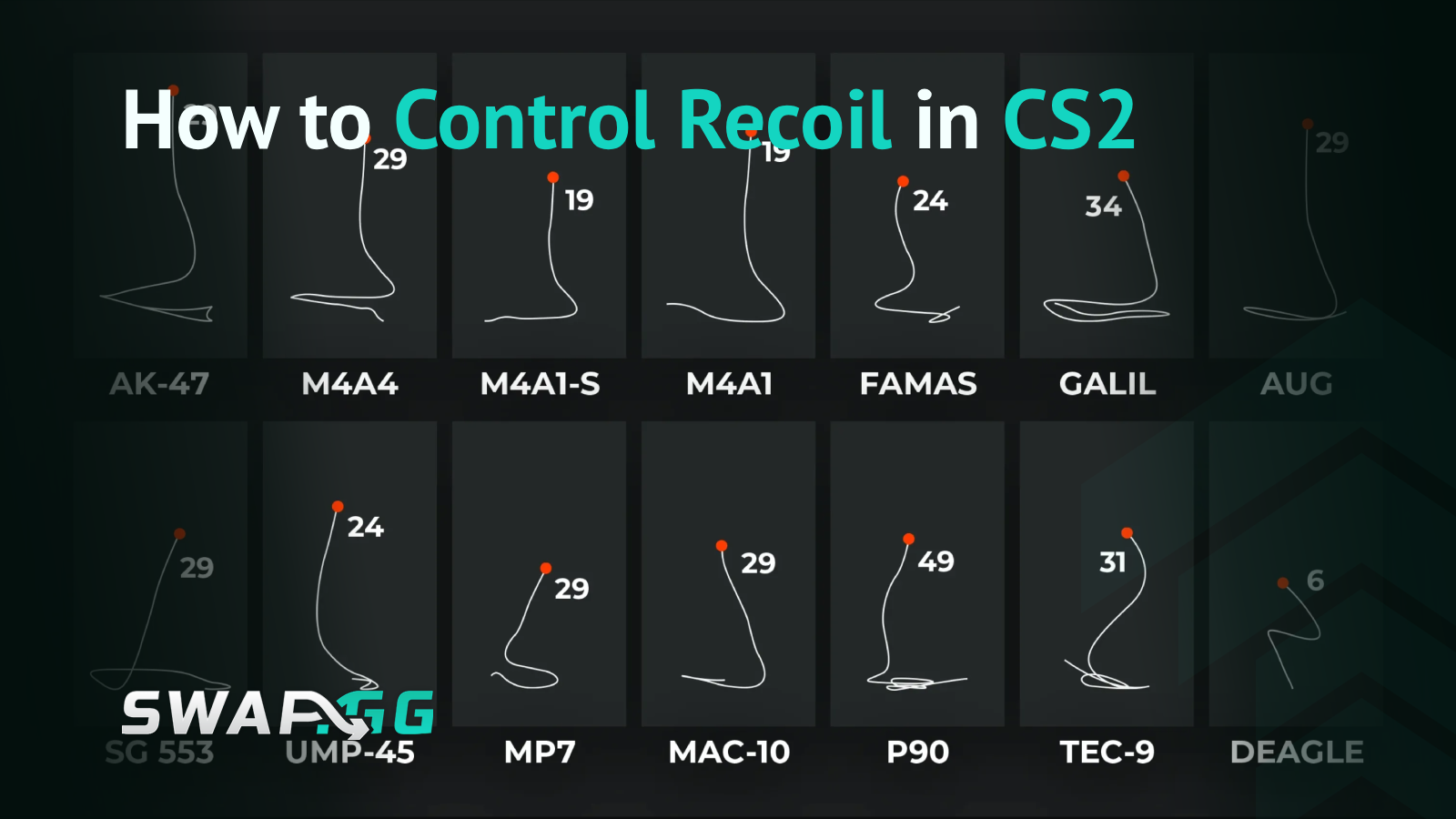
The first component is the spray pattern, which is fully predictable and weapon-specific. Every automatic weapon follows a fixed bullet trajectory when you hold down the trigger: the AK-47 climbs sharply upward for the first eight or so bullets, drifts left, then compensates right. That path never changes. It's the same every single time, which means it's learnable.

The second component is random spread, which introduces a small, unpredictable deviation on top of the spray pattern. Spread increases significantly when you're moving, jumping, or firing for extended durations. You cannot compensate for random spread through mouse movement, because it's genuinely random. What you can do is minimize it by standing still, crouching during longer sprays, and keeping your bursts short enough that spread doesn't compound.
A meaningful update came through in 2025 when Valve made CS2's recoil frame-independent. Before that change, players at lower frame rates sometimes experienced slightly different recoil behavior compared to those running high FPS. That inconsistency is gone now, which means the patterns you practice at 60 FPS are the same ones you'll see at 240 FPS. This brings CS2 recoil behavior closer to how CSGO's 128-tick servers felt, and it's genuinely good news for anyone building muscle memory on a budget machine.
The Core Mouse Technique Behind Spray Control
The mechanical idea behind recoil compensation is simple: your mouse moves in the opposite direction of where the bullets are going. If the spray climbs up and drifts left, you pull your mouse down and slightly right. What makes this hard is that the compensation needs to match the spray pattern's timing precisely, not just its direction.
A few things make a meaningful difference here.
Start your crosshair at the right height. At close range, you want to aim at head level before you begin firing, letting the upward recoil carry bullets into the body and torso zone. At longer ranges, the calculus changes: the spray pattern amplifies with distance, so the same upward kick that hits a torso at ten meters will fly completely over a head at fifty. For mid-to-long range sprays, starting your crosshair at chest level gives you a better chance of landing multiple bullets as the pattern rises naturally.
Counter the vertical climb first. The first eight to ten bullets of most rifles are almost purely vertical, which means a smooth downward pull is all you need in that window. Players who try to learn the full thirty-bullet spray immediately tend to make worse progress than those who nail the first ten bullets and build from there. The vast majority of duels are decided before bullet fifteen anyway.
Keep your corrections smooth, not jerky. The biggest mechanical mistake in spray control is over-correcting. When you pull down too aggressively trying to compensate, you overshoot the pattern and bullets start hitting the floor. The movement should feel continuous and even, similar to slowly dragging a cursor across a screen. Jerky corrections compound errors rather than fixing them.
Your DPI and sensitivity matter more than people admit. Lower DPI settings (400-800 DPI) give you more physical mouse travel per degree of in-game turn, which makes fine spray adjustments easier to execute precisely. Most players who struggle with spray control at high sensitivity find that their corrections are too twitchy to be consistent. If your current sensitivity puts you in the 2-4 eDPI range (sensitivity multiplied by DPI), you're in a workable range for learning spray control. Much higher than that and precise compensation becomes physically harder to repeat.
Spray Patterns for the Weapons That Actually Matter
Learning every weapon's spray pattern at once is a reliable way to learn none of them properly. The practical approach is to start with whichever rifle you play most, build that into genuine muscle memory, and then expand from there.
AK-47
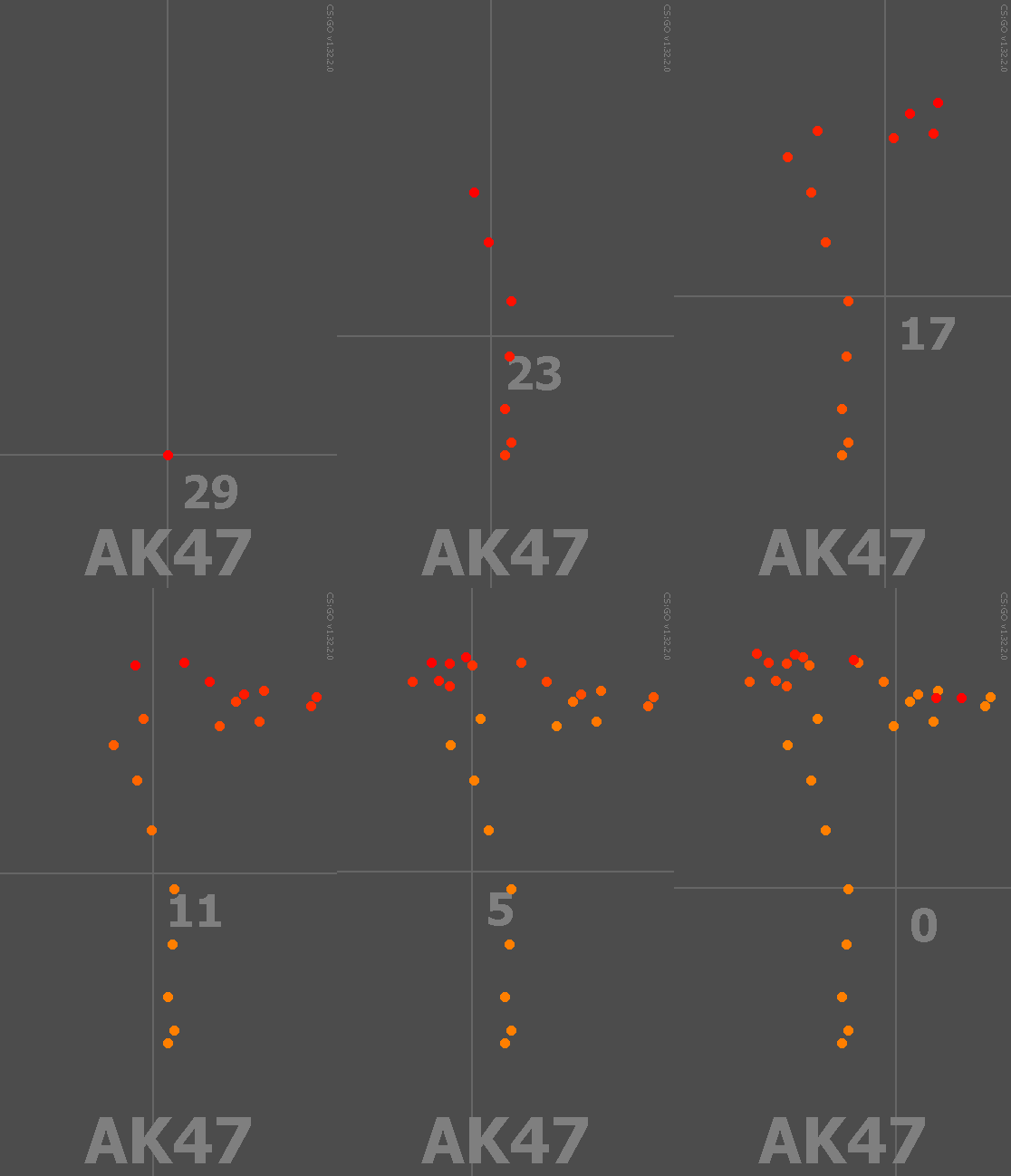
The AK-47 is the most punishing rifle to spray with and the most rewarding to master. Its pattern starts with a sharp upward climb over the first eight bullets, then shifts into a leftward drift around bullets nine through twelve, followed by a rightward correction from about bullet thirteen onward, where the pattern continues alternating between sides.
Compensation: pull straight down for the opening burst, then add a slight rightward adjustment to counter the left drift, then ease back left. The first ten bullets are where most kills happen, and the good news is that the vertical portion is the most consistent and learnable part of the pattern.
The AK's one-shot headshot capability means that even partial spray control, where you manage the first five to eight bullets cleanly, wins most duels at normal engagement distances.
M4A4
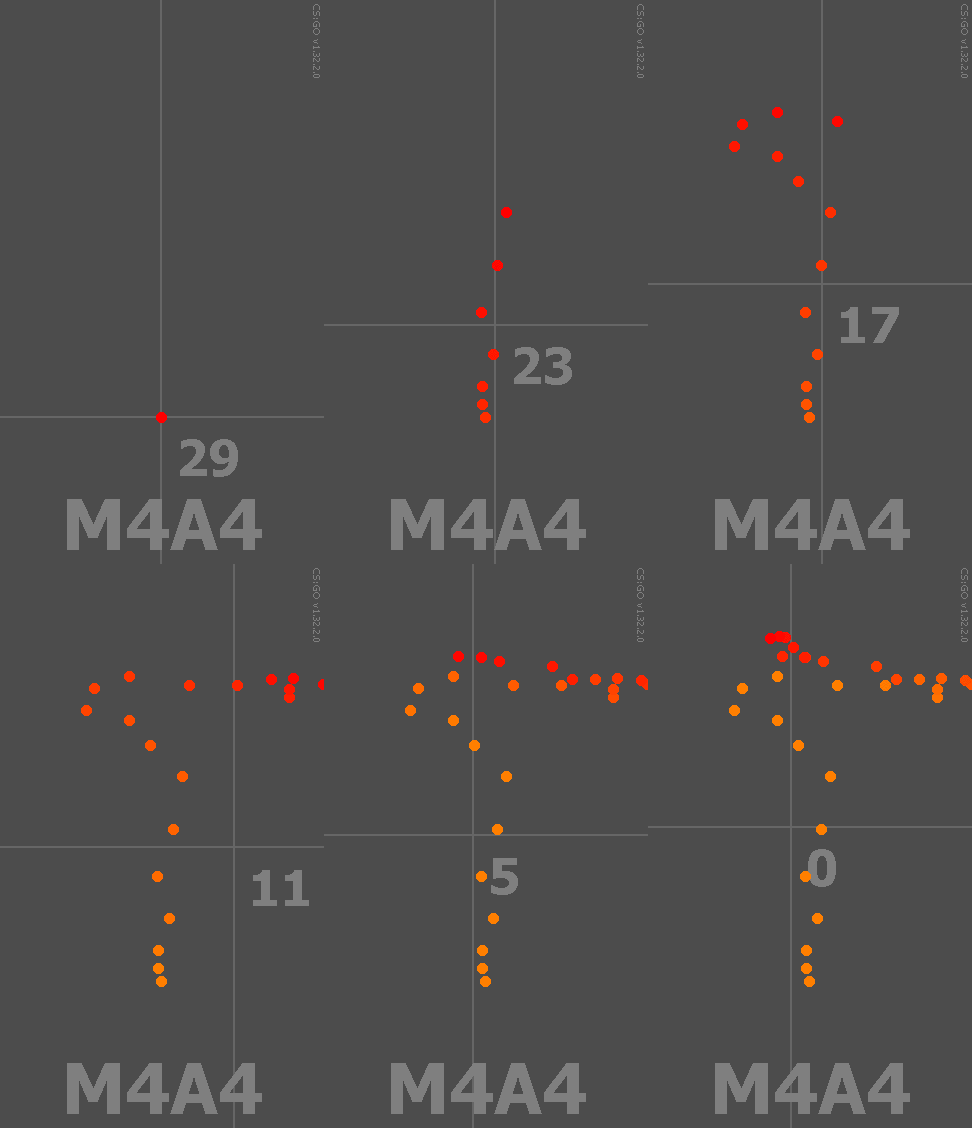
The M4A4's pattern is similar in shape to the AK but slightly tighter overall, with a strong upward climb followed by right deviation in the mid-spray range and then a leftward correction. The compensation sequence is: pull down, add a slight left correction to counter the rightward drift, then ease back right as the pattern shifts.
Because the M4A4 requires two headshots to kill, full spray potential matters more here than with the AK. Players who master the M4A4's pattern get more value from it than those who do not, since the gun's larger magazine (30 rounds vs. the AK's 30) gives you more room to work through a spray if you're controlling it well.
M4A1-S
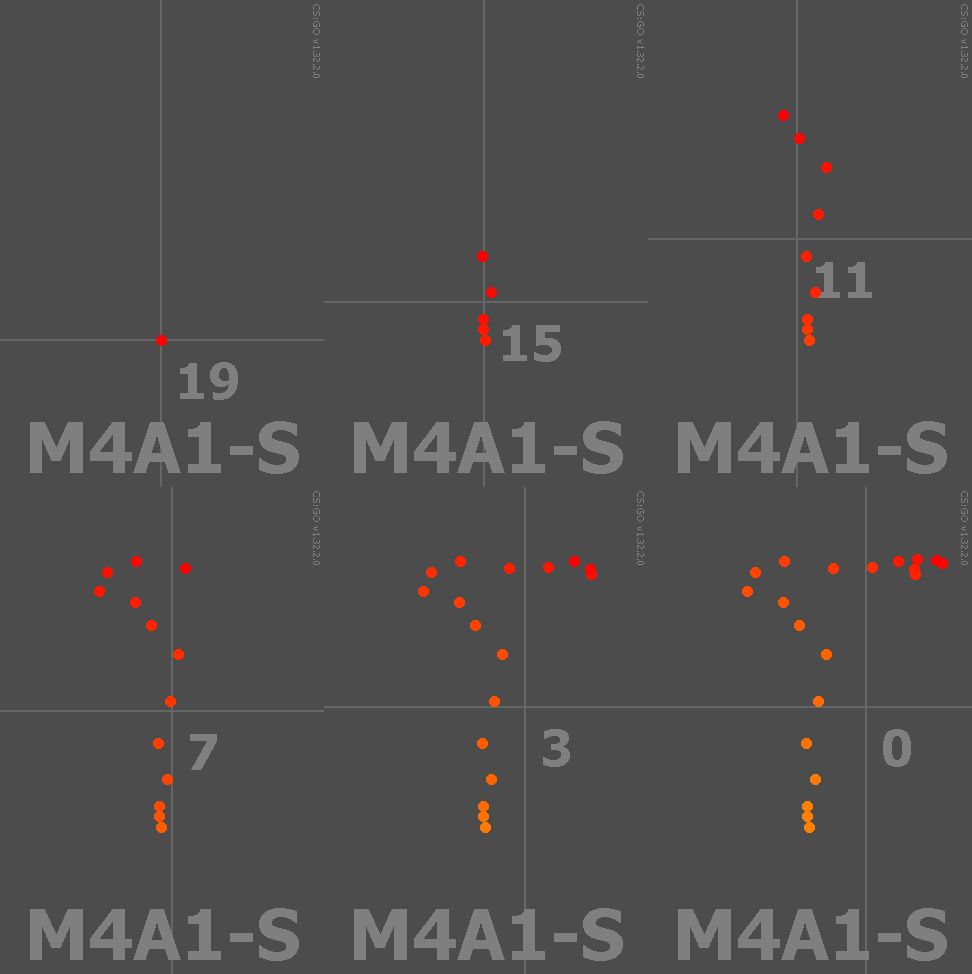
This is the most forgiving rifle in the game for recoil purposes. The pattern is predominantly vertical for the first nine bullets with only minor leftward drift, followed by a small rightward movement. A smooth, steady downward pull handles most of what the gun does. The trade-off is the smaller magazine (20 rounds), which means you burn through ammo faster if sprays go long. At mid-range, the M4A1-S rewards players who control their burst length and don't rely on extended sprays.
Galil AR and FAMAS
Both of these rifles appear frequently in eco or force-buy rounds and are worth knowing if you want to make the most of limited-economy situations. The Galil's pattern climbs vertically and veers right before correcting left; the pull is down and slightly right, then easing left. The FAMAS has a shorter magazine and a somewhat erratic horizontal component in the later bullets, which makes burst-firing a better default strategy with it than trying to control a full spray.
SMGs (MP9, MP7, MAC-10)
SMGs have faster rates of fire and tighter initial spreads, but they reward different habits than rifles. The MAC-10, in particular, sprays very quickly and requires a steady downward pull with slight lateral adjustments to keep bullets grouped. At close range where SMGs are most effective, the high fire rate means mistakes accumulate fast, so the first seven or eight bullets matter enormously.
Console Commands That Make Practice Significantly More Efficient
Before you start drilling patterns, spend five minutes setting up a practice environment using CS2's console. These commands turn an empty server into a genuinely useful training space.
Open your private server and enter:
- sv_cheats 1 (enables the following commands)
- sv_showimpacts 1 (shows bullet impact markers so you can see exactly where your spray is landing)
- sv_infinite_ammo 2 (gives infinite magazine, no reload, so you can spray continuously)
- bot_stop 1 (freezes bots in place if you want stationary targets)
- sv_showimpacts_time 5 (keeps impact markers visible for five seconds, giving you time to analyze your pattern)
Stand roughly ten meters from a flat wall, hold down the trigger, and let the spray pattern appear in front of you. Then spray again while trying to compensate, and compare the grouped impact cluster against what you got without compensation. That visual feedback is far more useful than any written description of what a pattern looks like.
Workshop Maps Worth Your Time
Two workshop maps are genuinely worth downloading for anyone serious about improving their recoil control.
Recoil Master (by Dolnma) is the most widely used spray training map in the CS community. It displays a ghost pattern on the wall showing the weapon's spray trajectory in real time, so you can see your compensation overlaid against the ideal path. The visual feedback loop accelerates learning considerably compared to blind wall practice.
Yprac Recoil Control takes a slightly different approach, giving you static and moving targets to spray at with built-in accuracy scoring. This is useful once you've got the pattern itself dialed in and want to train applying it against actual targets rather than a blank wall.
Both maps are free on the Steam Workshop and take thirty seconds to install. There is no good reason to skip them if you're putting in practice time.
The Daily Drill That Builds Real Muscle Memory
The mistake most players make with recoil practice is doing long, infrequent sessions. Spending ninety minutes once a week on Recoil Master is far less effective than spending ten to fifteen minutes every day. Muscle memory is built through repetition over time, not volume in a single sitting.
A practical daily routine that fits in fifteen minutes:
Start with five minutes of pure wall sprays on Recoil Master with your primary rifle. Focus on the first ten bullets and try to get them landing in a tight cluster. Do not advance to the full thirty-bullet spray until the ten-bullet version feels automatic.
Spend the next five minutes on Yprac with a moving target or two, trying to apply the spray while adjusting for small target movement. This bridges the gap between clean wall practice and real combat.
Use the final five minutes in a deathmatch server. Pick fights at close and medium range where full sprays are appropriate, and consciously try to apply what you practiced rather than reverting to panic-spraying.
After two weeks of this routine, most players notice their spray control in actual matches starts to feel more deliberate and consistent. The wall sessions build the motor pattern; the deathmatch sessions teach your brain when to apply it.
When Not to Spray
Recoil control is a tool, not a default. There are situations in CS2 where spraying is genuinely the wrong choice, and recognizing them is part of playing the mechanic intelligently.
At long range, even controlled sprays become less reliable because random spread amplifies with distance. Tapping or burst-firing (two to four bullets, then a brief pause to let the accuracy reset) is significantly more accurate at long-range angles. The brief pause for accuracy reset is typically around 0.4-0.5 seconds for most rifles.
While moving, your accuracy drops sharply because movement increases spread. Counter-strafing (tapping the opposite directional key to stop your momentum before firing) is the technique that lets you combine mobility with accuracy. The moment your character comes to a full stop, your spread resets to its standing-still value, and a controlled spray becomes viable again. Building counter-strafing into your movement is what separates players who can spray accurately at medium range from those who cannot.
If your positioning is bad, spraying is almost always wrong. A spray takes time, commits you to a location, and makes repositioning harder mid-fight. Short bursts or single taps that let you stay mobile are usually the smarter choice when you're caught off-angle or need to play for information.

发布于 在 CS2