How to Get Good Aim in CS2: The Complete Guide to Fragging More Consistently

Publicado el en CS2
Your aim in Counter-Strike 2 feels inconsistent because some days you're hitting everything while other days you can't land a shot. The difference comes down to fundamentals most players ignore once they think they've learned to aim.
This guide breaks down the mechanics that separate decent aimers from players who consistently win duels. You'll learn how to build muscle memory that transfers to real matches, fix the mistakes that tank your consistency, and set up your hardware correctly.
Crosshair Placement Matters More Than Raw Aim
Most players focus on flicking to heads when they should focus on never needing to flick in the first place. Crosshair placement is the difference between reacting in 150ms and reacting in 400ms.
The Basics of Head-Level Crosshair Placement
Your crosshair should sit at head level in the exact spot enemies are most likely to peek from. When you round a corner or hold an angle, your crosshair should already be on their head before they appear.
Most engagements happen at head level, roughly the height of a standing player model's head. On most maps, this means keeping your crosshair aligned with objects at approximately player head height:
- Crates and boxes
- Railings and ledges
- Tops of short walls
- Window sills
As you move through the map, your crosshair should trace along this invisible line, adjusting only when terrain changes or you're checking common off-angles.
Angle Types and When to Use Them
The angle you're holding determines your positioning advantage.
Tight angles (close to the corner) let you see enemies before they see you because of how CS2 handles player models and angles. Most skilled players default to tight angles when holding.
Wide angles (far from cover) give you more time to react but expose you to multiple positions at once. Players typically swing wide when they're the aggressor because it's harder for defenders to track.
Common Crosshair Placement Mistakes
Three mistakes destroy your crosshair placement before fights even start:
- Looking at the ground while running adds 30-40 degrees of vertical adjustment to every fight
- Aiming at chest level instead of heads gifts your opponent 100-150ms of reaction time advantage
- Pre-aiming the center of doorways instead of the angles where enemies actually peek from corners
Sensitivity and DPI: Finding What Actually Works
The 400 DPI at 1.5-2.5 sensitivity range became standard because it balances precision with turning speed. If you're running 3200 DPI at 4.0 sensitivity, you're making precision physically impossible.
Understanding eDPI
Your effective DPI (eDPI) is your DPI multiplied by your in-game sensitivity. Most professional players sit between 600 and 1200 eDPI.
If you're changing sensitivity constantly, you're never building muscle memory. Your brain needs thousands of repetitions at the same settings to develop the neural pathways for accurate aim.
The Setup Process
Pick something in the 800-1000 eDPI range if you're unsure, then follow this process:
- Play 50 deathmatch games without touching it
- Make small adjustments (5-10% maximum) if needed
- Commit to the new setting for another 50 games
Mouse acceleration should be disabled in Windows. CS2's raw input bypasses most Windows settings, but acceleration fundamentally breaks the 1:1 relationship between hand movement and crosshair movement.
Mouse Pad Requirements
You need enough space for a full 180-degree turn without picking up the mouse mid-fight. Large cloth pads (450mm x 400mm or bigger) give you room to use your arm for broad movements and your wrist for micro-adjustments. Hard pads feel faster but provide less stopping control, which makes small corrections harder.
Hardware Setup That Doesn't Sabotage You
Monitor and Display Settings
Your monitor's refresh rate directly impacts your ability to react. Most gunfights are decided by 50-100ms reaction time differences, so even small reductions matter.
Mouse Settings That Matter
Mouse sensor quality matters less than it used to, but polling rate still makes a difference:
- 125Hz: Mouse reports position every 8ms
- 1000Hz: Mouse reports position every 1ms (smoother cursor movement)
Make sure your mouse software isn't applying smoothing or angle snapping. These features feel helpful initially but prevent you from developing precise muscle control.
Frame Rate Stability
Frame rate stability matters more than maximum frame rate. Jumping between 200 and 400 fps feels worse than staying locked at 240 fps because the inconsistency changes how your movements translate to screen motion.
Cap your frame rate at something your system maintains consistently, or use RTSS (RivaTuner Statistics Server) to enforce frame pacing. Most players find 240-300 fps provides enough smoothness without instability.
Desk Ergonomics
Your desk height and chair setup affect aim more than you'd expect:
- Elbow should be roughly level with your desk or slightly below
- Monitor at eye level or slightly below
- Arm shouldn't angle up (fighting gravity) or down too much (losing range of motion)
Aim Training That Actually Transfers to Matches
Most aim training feels good but doesn't improve performance in real games because it focuses on scenarios you'll never encounter, like flick training on static targets when enemies are actually strafing.
What Effective Aim Training Looks Like
The most effective aim training replicates real CS2 mechanics:
- Counter-strafing before shooting
- Targets that peek and hide like actual players
- Scenarios requiring crosshair placement instead of pure reaction
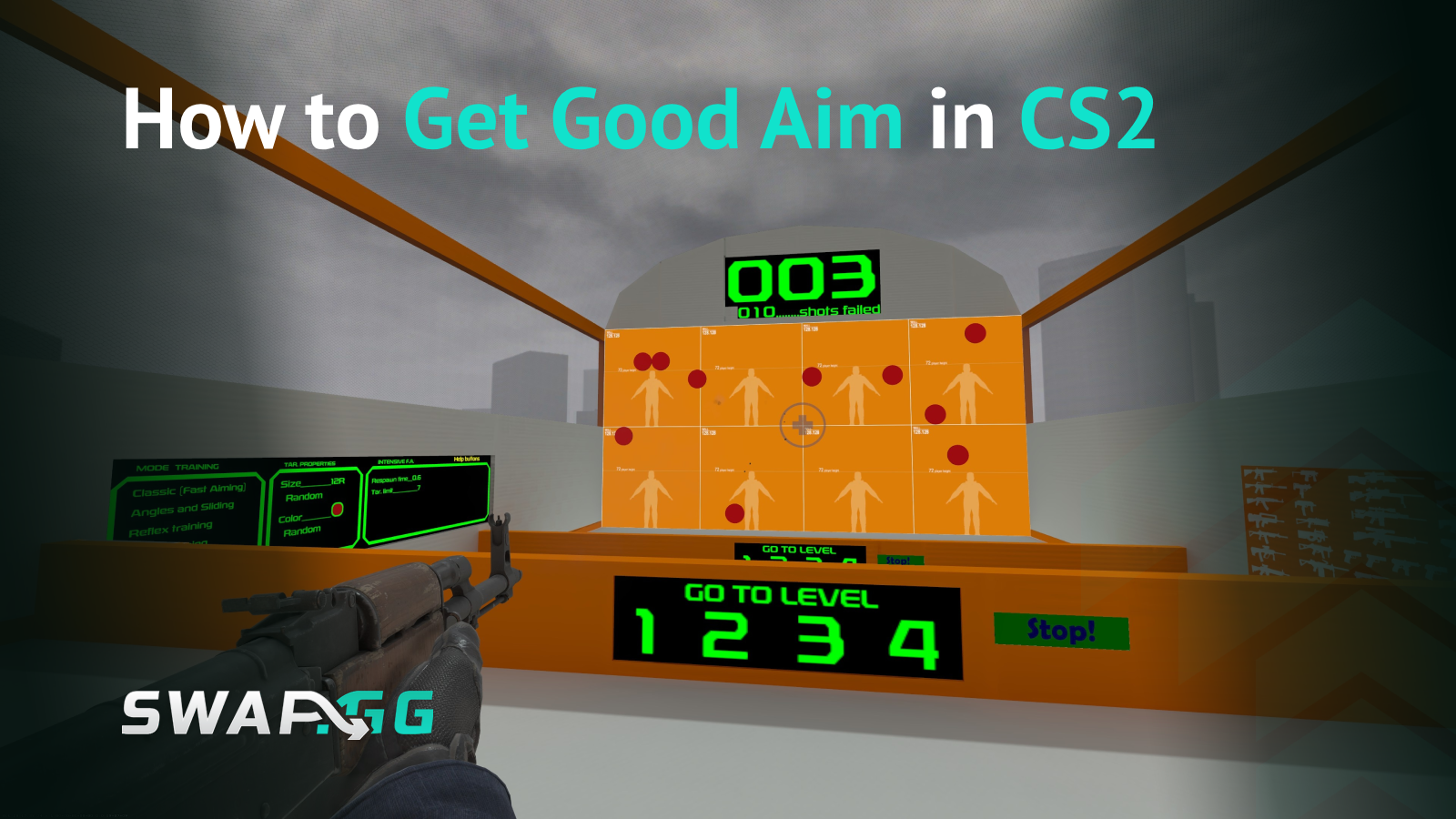
Workshop maps like Aim Botz work well because you practice the entire shooting sequence: spot enemy, stop movement, shoot. This is different from just moving your mouse to a target.
Daily Practice Routine
For players below 10,000 hours in tactical shooters, fundamental exercises beat complex drills.
Start every session with:
- 10-15 minutes of Aim Botz or similar map
- Focus on one-tapping heads while moving between positions
- No spraying, no body shots
- Make the shot harder than necessary so real fights feel easier
If you're hitting 80-90% headshots in practice, you'll hit 60-70% in matches where enemies shoot back.
Spray Control Development
Spray control comes from understanding the pattern, not from raw repetition. The AK-47's recoil follows a specific pattern: straight up for the first few bullets, then pulls left, then right.
Learning this pattern takes 30 minutes, but making it automatic takes hundreds of hours of consistent practice.
Practice progression:
- Master the first 10 bullets until you land all in a tight group
- Extend to 15 bullets
- Extend to 20 bullets
Most sprays in real matches don't exceed 10 bullets anyway, so master the fundamentals before trying to control full magazines.
Training Focus by Scenario
Movement and Shooting Mechanics
You can't shoot accurately while moving. CS2's movement inaccuracy is severe. The counter-strafe mechanic is how you stop instantly.
Counter-Strafing Fundamentals
If you're moving right (holding D), tap A briefly to stop your momentum, then shoot. This takes your velocity to zero faster than just releasing the key.
The timing is specific:
- Start your counter-strafe 50-100ms before you want to shoot
- Counter-strafe too late and you're still moving when you fire
- Counter-strafe too early and you start moving in the opposite direction
Most players never develop this timing because they practice shooting and movement separately instead of combining them.
Peeking Speed and What Enemies See
Your movement speed affects what you see versus what enemies see.
Wide peeking at full speed: Enemies see you before your screen updates with their position because of how the server processes movement and position updates.
Clearing angles at walk speed: You see enemies at roughly the same time they see you, but you're also an easier target.
The correct speed depends on whether you're trying to catch someone off-guard or maintain accuracy while clearing multiple positions.
Jiggle Peeking
Jiggle peeking (rapidly strafing in and out of cover) baits shots while gathering information. Done correctly, you're exposed for less than 200ms, which is faster than most players' reaction time plus the time to move their mouse and click.
But jiggle peeking incorrectly with bad counter-strafe timing means you're moving when you try to shoot your next bullet, which wastes the timing advantage you just created.

The Crouch Decision
The crouch mechanic in CS2 changes your spray pattern by lowering your camera and tightening your accuracy. But crouching mid-spray commits you to the fight because you move much slower.
When to crouch:
- You're committed to the spray
- You're confident in your positioning
- You don't need to retreat
When to stay standing:
- You might need to back up
- You need to reposition quickly
- You're not certain about committing to the fight
Building Muscle Memory That Actually Sticks
Muscle memory is your brain optimizing motor patterns through repetition. It requires specific, deliberate practice, not mindless grinding.
Focused Practice vs. Autopilot Grinding
If you're playing deathmatch while distracted or on autopilot, you're reinforcing whatever habits you currently have, including bad ones.
Focused practice means choosing one specific skill and drilling it correctly for 15-30 minutes. If you're working on counter-strafing, every engagement in deathmatch should focus on nailing that mechanic, even if it means you die more often initially.
Quality Over Quantity
One hundred perfect repetitions build better muscle memory than one thousand sloppy ones. A 2017 study by researchers at Johns Hopkins found that introducing slight variations during practice sessions improves skill retention compared to identical repetitions.
This means mixing up your angles, positions, and engagement distances during practice helps your brain generalize the skill instead of memorizing specific scenarios.
Consistency Across Sessions
Practicing 20 minutes daily beats a three-hour session once per week because skill consolidation happens during sleep and between practice sessions. Your brain needs time to strengthen neural pathways, which happens when you're not actively practicing.
Context-Dependent Transfer
Muscle memory is context-dependent. If you practice in aim trainers with no movement mechanics and perfect visibility, that muscle memory doesn't transfer cleanly to matches with smokes, flashes, teammate callouts, and pressure.
Aim training needs to replicate match conditions as closely as possible, or you need to spend more time in actual matches where the context is already correct.
Positioning and Angles That Make Aim Easier
Good positioning cuts your required aim precision in half. If you're standing in the open fighting three angles at once, you need perfect aim to survive. If you're holding one tight angle with cover behind you, you only need to land shots on targets appearing in one specific spot.
Off-Angles and Timing
Off-angles (positions where enemies don't expect you) give you 200-400ms of free reaction time because opponents pre-aim common spots. The trade-off is that off-angles usually lack easy escape routes.
Using them effectively means taking your fight, getting your kill, and immediately repositioning before enemies adapt. Sitting in the same off-angle twice gets you killed the second time.
Distance Management
Distance management determines which weapon has the advantage. Holding long-range angles with an M4A4 or AK-47 means you're fighting within your weapon's optimal range. Letting riflers close distance while you're holding a site means you're fighting in their preferred engagement range.
Most players lose fights not because their aim failed, but because they fought at the wrong distance for their weapon and position.
Cover Usage
Cover usage is binary because you're either using cover or you're not. Half-covering yourself means you've given up the protection without gaining any advantage.
When you're behind cover, commit to being behind cover until you're ready to peek, and when you peek, commit to the fight.
Trading Kills and Crossfire Setup
Playing close to your teammate means you can trade kills easily. Playing far from your teammate means if you die, they're in a 1v2 before they can help.
Most failed site holds happen because players spread too far apart, letting attackers isolate and kill defenders one at a time. Good positioning means setting up crossfires where either you or your teammate has an easy shot on anyone fighting the other player.
Mental Game and Consistency Under Pressure
Your aim feels worse in clutch situations because stress narrows your focus and increases muscle tension. Under pressure, most players make too many micro-corrections instead of trusting their initial placement and taking the shot.
Accepting the Accuracy Cone
CS2 has inherent accuracy variance, which means even perfectly aimed shots can miss because of the accuracy cone built into every weapon.
Players who understand this take their shot confidently and immediately reposition if they miss. Players who don't understand it hesitate, adjust excessively, and die before shooting.
Pre-Match Routines
Most professionals warm up with the same routine every time, not because the specific routine matters, but because the consistency signals to their brain that it's time to perform.
Whether that's 15 minutes of aim training followed by two deathmatch games or 30 minutes of retake servers doesn't matter as much as doing the same thing each time.
Reviewing Your Deaths
When you die, ask yourself specific questions:
- Was it crosshair placement?
- Movement timing?
- Did you peek too wide?
- Did you take too long to shoot?
Most players blame "aim" when the real problem was positioning or decision-making that forced them into impossible fights.
The Reality of Improvement
Aim improvement follows a logarithmic curve, which means new players improve rapidly because everything helps, while experienced players improve slowly because they're refining small details.
Most improvement happens in chunks rather than linearly, where you plateau for weeks until something clicks and your consistency suddenly jumps up a level. The plateau periods aren't wasted time because your brain is consolidating skills, strengthening neural pathways, and eliminating inefficient movement patterns.
Your Baseline Matters More Than Peak Performance
You'll have days where every shot hits and days where nothing works, but the difference between these extremes is often just sleep quality, caffeine timing, or random variation in motor performance.
What matters is your baseline: the performance level you maintain consistently over weeks and months, not your best day.
Fundamentals vs. Aim Problems
Most players who think they have an aim problem actually have a fundamentals problem. They're peeking incorrectly, positioning poorly, or taking fights at the wrong range.
Fixing the fundamentals (crosshair placement, counter-strafing, positioning) provides bigger improvements with less time investment than pure aim training.

Publicado el en CS2