Animgraph 2 Beta: What Changed, Why It Matters & How to Enable It

Publicado el en CS2
On April 1, 2026, Valve dropped a beta build that a lot of people initially wrote off as an April Fools' joke, and the ones who actually looked into it realized it was one of the most technically significant updates CS2 has ever received. The Animgraph 2 beta is a full ground-up rebuild of how CS2 handles player animations, covering everything from how a model moves when you counter-strafe to how the server communicates animation data to your client. That last part is where things get genuinely interesting for anyone who cares about performance and gunfight consistency, because the old system was carrying real overhead that showed up in the moments that mattered most.
What Animgraph 2 Actually Is and Where It Came From
Animgraph 2 is CS2's updated animation system built on top of Source 2. It controls how every player model moves, transitions between actions, and visually represents what's happening in real time for everyone watching, which in Counter-Strike means everyone except the player themselves.
The rollout has been happening in two phases. Back in July 2025, Valve already pushed Animgraph 2 to first-person animations, which covered reload, inspect, deploy, and firing sequences. The April 2026 beta completes that work by bringing all third-person animations over to the new system, and since third-person is what every other player in the server sees when they're watching you move, this phase has the bigger competitive impact.
The old system worked by having the server manually track animation cycles and constantly force clients to sync up. Every player entity required the server to push full animation state data on each tick, which added up fast in a full lobby and created the desync moments where a model looked like it was still moving when the server had already registered it as stopped. Animgraph 2 switches to a token-based approach, where the server sends a state-change token rather than a full animation loop, and each client reconstructs the animation from there. Less data transmitted, less CPU load per entity, and cleaner sync between the server's reality and what you see on your screen.

What Changed in the Third-Person Animations
Every single third-person animation in the game has been re-authored from scratch, with many of them adjusted specifically in response to player feedback, not just rebuilt for technical reasons. The most visible change is counter-strafing. Under the old system, when a player hit the opposite movement key to stop and shoot, the model would slide awkwardly into position with barely any readable visual signal about whether they had actually stopped. The new system makes the model physically dig in and shift its weight when a counter-strafe happens, so the direction change is readable and the timing is visible. For anyone holding an angle, that's a direct competitive improvement, because you now have a real tell to work with rather than guessing from a sliding model.
Knife pullouts, weapon swaps, and in-air crouch transitions all now mirror what the first-person player is doing, which wasn't reliably true before. Player models feel more planted overall, with jittery movement artifacts significantly reduced, and the relationship between where a player's head visually appears and what they can actually see from that position is now more accurate, particularly on sloped surfaces.
Player occlusion also got its own separate fix: it now uses a GPU query rather than the old method, which stops player models from clipping through thin walls when their bounding volume has no visible geometry on the other side.
What the April 14 Follow-Up Fixed
A second beta patch came on April 14, 2026, focused entirely on issues the community reported after testing the initial build. The fixes included wrong character poses when backing into corners, animation popping when switching weapons after throwing a grenade, exaggerated head wobbling while planting the C4, missing knife draw animations, and stuttering in third-person aiming. These kinds of targeted follow-up patches are a good sign that Valve is treating this beta seriously rather than just shipping it and moving on.
How This Connects to Peeker's Advantage
Peeker's advantage in CS2 has two separate causes that often get conflated. One is pure network latency, where the peeking player's client shows them the defender before the defender's client registers the incoming peek. Animgraph 2 doesn't solve that part. What it does address is the second cause: the visual desync between what the server registered and what you saw on your screen because animation data was being transmitted inefficiently.
When the server switches to token-based state changes, animation states reach clients more accurately and with less delay, which means the model you're aiming at more closely represents where the server actually considers that player to be. The counter-strafe readability improvement compounds this further, because you can now actually see from the model whether an enemy has stopped moving, rather than guessing based on a lag-smoothed slide. The combination doesn't eliminate peeker's advantage entirely, but it does close the gap on the visual information side of it.
Performance: What the Numbers Actually Show
Valve's stated goal with Animgraph 2 is to reduce both CPU and networking costs tied to animation processing, and community benchmarks from early testers back that up in a specific way. On a Ryzen 5600X with a 3060 Ti, average frames went from 591 to 596 pre- and post-beta, which looks small on its own, but the 1% low FPS (the number that determines how smooth the game actually feels in fast fights) went from 178 to 180.6 in the same test. Benchmarks on the official Dust2 FPS test maps showed 1% lows climbing from 256.9 to 324 FPS on higher-end hardware, and some players reported average frame gains in the 8% range on older or mid-tier CPUs.
The pattern across most reports is the same: average frames improve modestly, but frame time stability, measured by 1% and 0.1% lows, improves more noticeably. In practical terms, that's the difference between a game that reads "300 fps" on screen and still stutters during a five-player fight, versus one that actually holds that smoothness when the situation is most demanding. CPU-bottlenecked setups see the biggest gains; GPU-limited setups at high resolution and max settings will mostly notice less stutter rather than raw FPS jumps.
The Ramp Height Change and What It Means for Grenades
One part of this update that most players are sleeping on: the ramp height logic in the Source 2 engine was completely refactored alongside the animation work. Previously, the player height calculated on a sloped surface varied depending on which direction you approached it from, and that inconsistency had been present since CS2 launched. Some grenade lineups were accidentally built around it without players realizing, because the game just always behaved that way.
With Animgraph 2, player height on ramps is now consistent from every approach angle. That means a lineup you've thrown from the sloped part of Nuke's outside, or from a ramp position on Mirage or Overpass, may land in a different spot than it used to. Valve's own patch notes confirm this directly: "grenade lineups on sloped surfaces may have changed." It's worth putting your most-used ramp nades into a practice server and checking them before this hits the main branch, because everyone will be caught off guard at the same time when it does.
What Was Found in the Game Files
Data miners going through the April 2 beta build found a few things that have nothing to do with animations but are worth knowing about. A "Cash Stack" object appeared in the files, attributed to dataminer Aquaismissing, that grants $250 when picked up and plays the exact pickup animation from the old Danger Zone mode. The spawn command is listed as spawnCashStack, and it works autonomously in any mode. Separately, dataminer Gabe Follower found new paintball-style bullet decals in the code. Neither feature is active in the current beta, but the code is there and functional, which is more than speculative teasing. Whether that means a Danger Zone revival, a new limited mode, or something else entirely, Valve hasn't said.
How to Enable the Animgraph 2 Beta
The process runs through Steam directly and takes a few minutes:
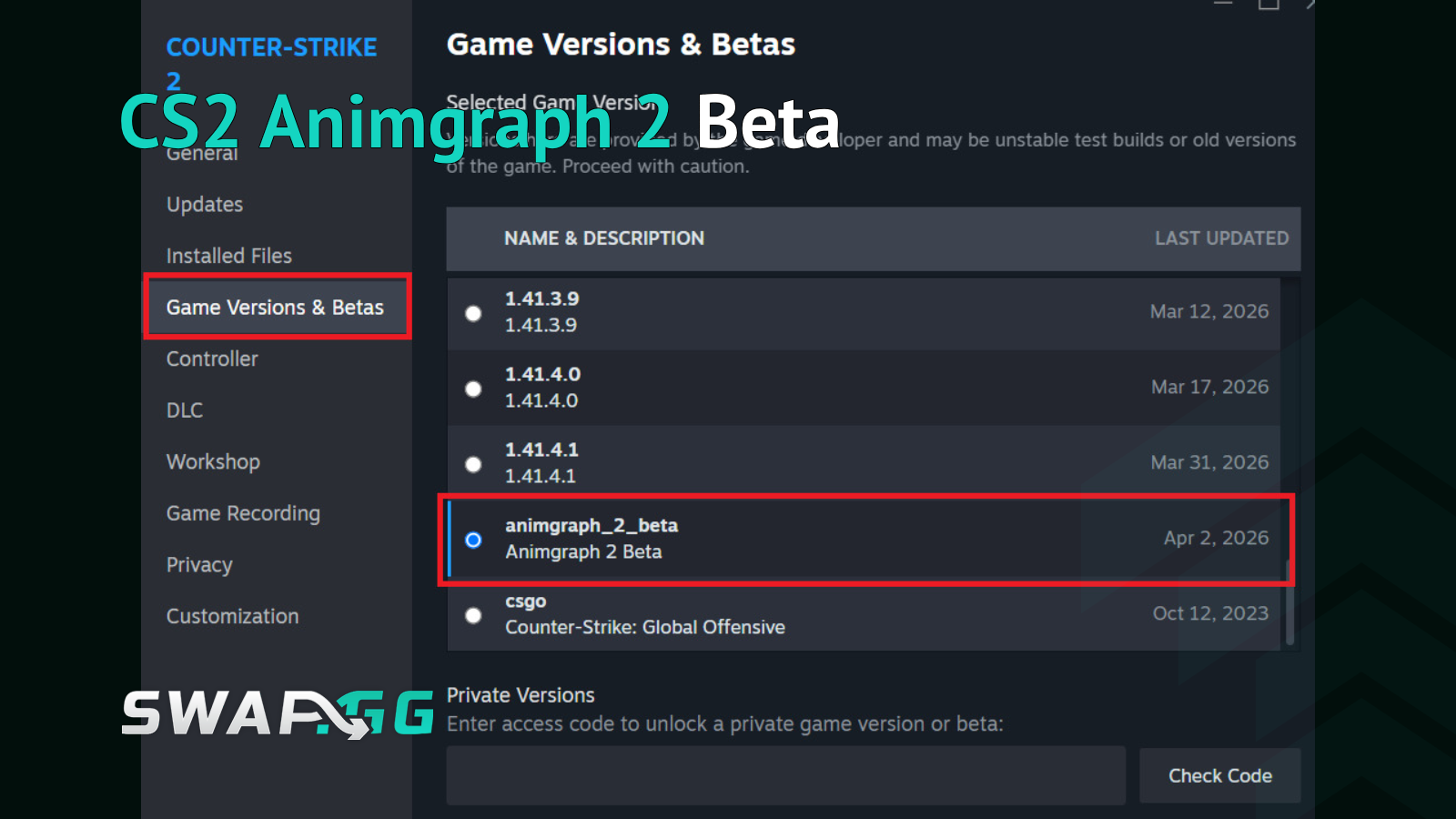
- You open Steam and right-click Counter-Strike 2 in your library.
- You select Properties.
- You open the Betas tab (labeled "Game Versions & Betas" in some Steam versions).
- You scroll down in the dropdown and select "animgraph_2_beta."
- You let Steam download the update (roughly 3 GB) and launch the game.
Two things to know before opting in: you cannot connect to official Valve servers while on this branch, so Premier, Competitive matchmaking, and Deathmatch are all unavailable. You're limited to offline modes, workshop maps, and community servers that have the beta build running. To switch back, you go to the same Betas tab and select the default public version. For bug reports, Valve specifically asked players to email [email protected] with the subject line "AG2 Beta," and the April 14 follow-up patch shows they are actively reading and acting on what gets sent in.
FAQ
Can you play ranked matchmaking with the Animgraph 2 beta enabled? No. The beta branch blocks access to Valve's official servers entirely, covering Premier, Competitive, and Deathmatch. You can only play offline, on workshop maps, or on community servers running the beta build.
Will Animgraph 2 break your existing grenade lineups? Some of them, yes. The ramp height calculation was refactored so player height on slopes is now consistent regardless of approach direction, and lineups that depended on standing on an angled surface may land differently. Verifying your most-used ramp nades in a practice server before the main branch release is worth doing.
Does Animgraph 2 actually improve FPS? For most players, yes, though the bigger gain shows up in frame stability rather than raw average frames. Community benchmarks showed 1% lows improving meaningfully, and players on CPU-bottlenecked hardware reported average gains around 8%. GPU-limited setups at high settings will see less stutter more than raw FPS jumps.
When will Animgraph 2 go live for everyone? Valve has not announced a date. The April 14 follow-up patch addressed a detailed list of community-reported bugs, which signals Valve is still iterating before pushing to the main branch. Based on the pace of that iteration, most players expect a live release within weeks rather than months, though nothing is confirmed.
How do you report bugs in the Animgraph 2 beta? You email [email protected] with the subject line "AG2 Beta." Valve confirmed this address in the original patch notes and has already shipped fixes based on reports sent there.

Publicado el en CS2